|
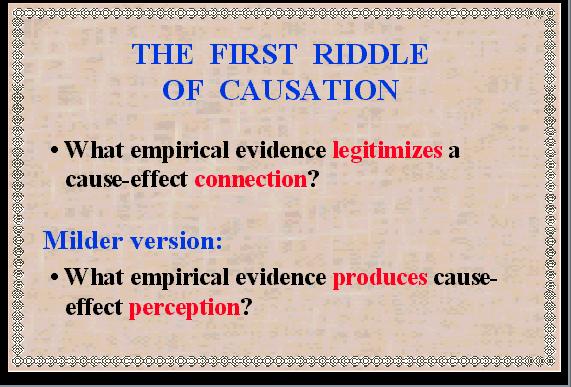
SLIDE 24: THE FIRST RIDDLE OF CAUSATION
We saw in the rooster example that regularity of succession
is not sufficient; what WOULD be sufficient?
What patterns of experience would justify calling
a connection "causal"?
Moreover: What patterns of experience
CONVINCES people that a connection is "causal"?
|
|
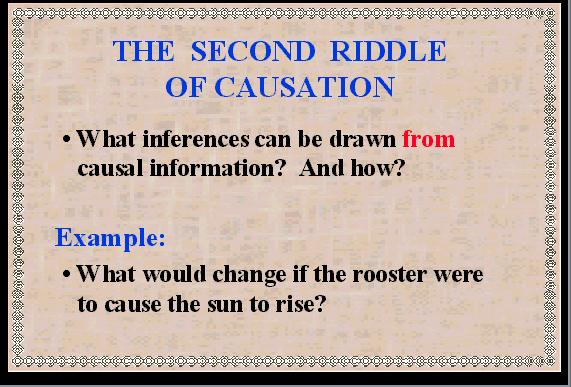
SLIDE 25: THE SECOND RIDDLE OF CAUSATION
If the first riddle concerns the LEARNING
of causal-connection, the second
concerns its usage:
What DIFFERENCE does it make if I told you
that a certain connection is or is not causal:?
Continuing our example, what difference does it make
if I told you that the rooster does cause the sun to rise?
This may sound trivial.
The obvious answer is that knowing what causes what
makes a big difference in how we act.
If the rooster's crow
causes the sun to rise we could make the
night shorter by waking up our rooster earlier and make him
crow - say by telling him the latest rooster joke.
|
But this riddle is NOT as trivial as it seems.
If causal information has an empirical meaning
beyond regularity of succession, then that information
should show up in the laws of physics.
But it does not!
The philosopher Bertrand Russell made this argument in 1913:
|
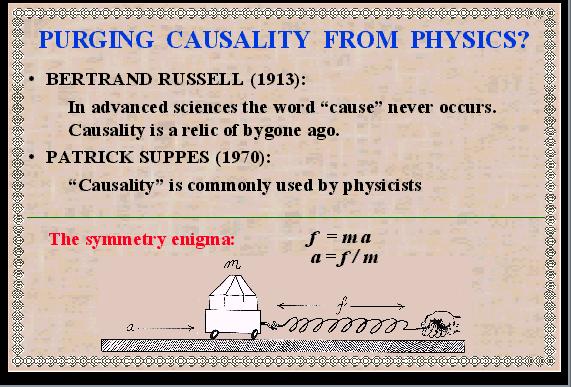
SLIDE 26: PURGING CAUSALITY FROM PHYSICS?
"All philosophers, "says Russell," imagine that
causation is one of the fundamental axioms of
science, yet oddly enough, in
advanced sciences, the word 'cause' never occurs ... The law of
causality, I believe,
is a relic of bygone age,
surviving, like the monarchy, only because it is
erroneously supposed to do no harm ..."
Another philosopher, Patrick Suppes, on the other hand,
arguing for the importance of causality, noted that:
"There is scarcely an issue of *PHYSICAL REVIEW*
that does not contain at least one article
using either `cause' or `causality' in its title."
|
What we conclude from this exchange is that
physicists talk, write, and think one way and formulate
physics in another.
Such bi-lingual activity would be forgiven if causality
was used merely as a
convenient communication device - a shorthand for expressing
complex patterns of physical relationships
that would otherwise take many equations to write.
After all! Science is full of abbreviations:
We use, "multiply x by 5", instead of "add x
to itself 5 times"; we say: "density" instead of
"the ratio of weight to volume".
Why pick on causality?
"Because causality is different," Lord Russell would argue,
"It could not possibly be an abbreviation,
because the laws of physics are all symmetrical, going both ways,
while causal relations are uni-directional, going from cause to effect."
Take for instance Newton's law
f = ma
The rules of algebra permit us to write this law
in a wild variety of syntactic forms, all meaning
the same thing - that if we know any two of the three quantities,
the third is determined.
Yet, in ordinary discourse
we say that force causes acceleration - not that
acceleration causes force, and we feel very strongly
about this distinction.
Likewise, we say that the ratio f/a helps us DETERMINE
the mass, not that it CAUSES the mass.
Such distinctions are not supported by the
equations of physics, and this leads us to ask whether
the whole causal vocabulary is purely
metaphysical.
"surviving, like the monarchy...etc."
Fortunately, very few physicists paid attention to Russell's enigma.
They continued to write equations in the office
and talk cause-effect in the CAFETERIA, with
astonishing success, they smashed the atom, invented the transistor,
and the laser.
The same is true for engineering.
But in another arena the tension could not go
unnoticed, because in that arena the demand for
distinguishing causal from other relationships was very
explicit.
This arena is statistics.
The story begins with the discovery of correlation,
about one hundred years ago.
|
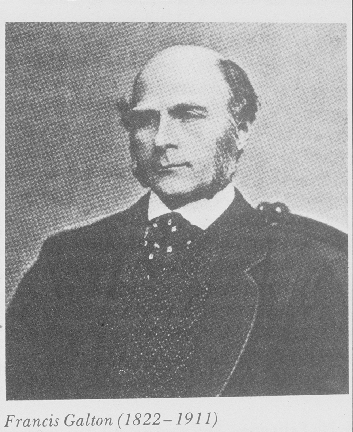
SLIDE 27: FRANCIS GALTON (PORTRAIT)
Francis Galton, inventor of fingerprinting and cousin
of Charles Darwin, quite understandably set out to
prove that talent and virtue run in families.
|
|
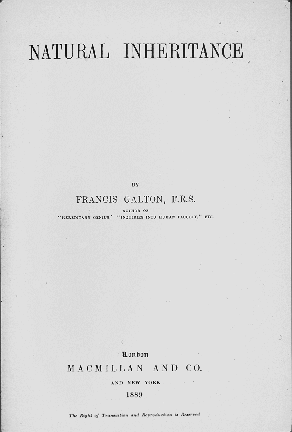
SLIDE 28: TITLE PAGE "NATURAL INHERITANCE"
These investigations, drove Galton to consider various ways of
measuring how properties of one class of individuals or objects are
related to those of another class.
|
|
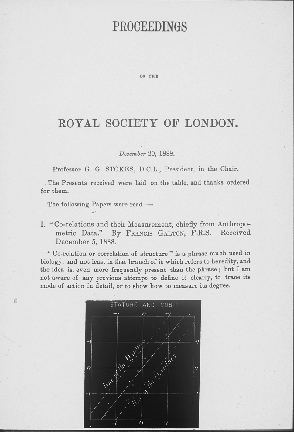
SLIDE 29: GALTON'S PLOT OF CORRELATED DATA (1888)
In 1888, he measured the length of a person's forearm and the
size of that person's head and
asked to what degree
can one of these quantities predict the other.
He stumbled upon the following discovery: If you
plot one quantity against the other
and scale the two axes properly,
then the slope of the best-fit line has some nice mathematical
properties:
The slope is 1 only when one quantity can predict
the other precisely; it is zero whenever the prediction
is no better than a random guess and, most remarkably, the slope
is the same no matter if you plot X against Y or Y against X.
"It is easy to see," said Galton, "that co-
relation must be the consequence of the variations of
the two organs being partly due to common causes."
Here we have, for the first time, an objective measure
of how two variables are "related" to each other, based strictly
on the data, clear of human judgment or opinion.
|
|
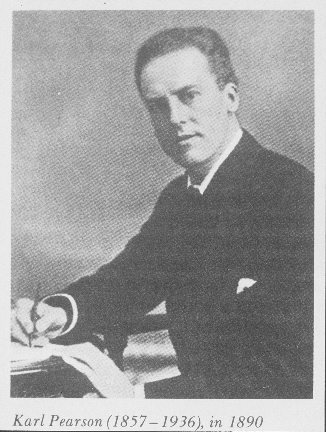
SLIDE 30: KARL PEARSON (PORTRAIT, 1890)
Galton's discovery dazzled one of his students, Karl Pearson, now
considered the founder of modern statistics.
Pearson
was 30 years old at the time, an accomplished physicist
and philosopher about to turn lawyer, and this is how he describes,
45 years later, his initial reaction to Galton's discovery:
|